DE or Cartridge Filter, and Why Both Need Cleaning Twice a Year
Your filter does the quiet work of keeping the water clear, and it can only do it while it isn't clogged.
October 27, 2026 · 4 min read
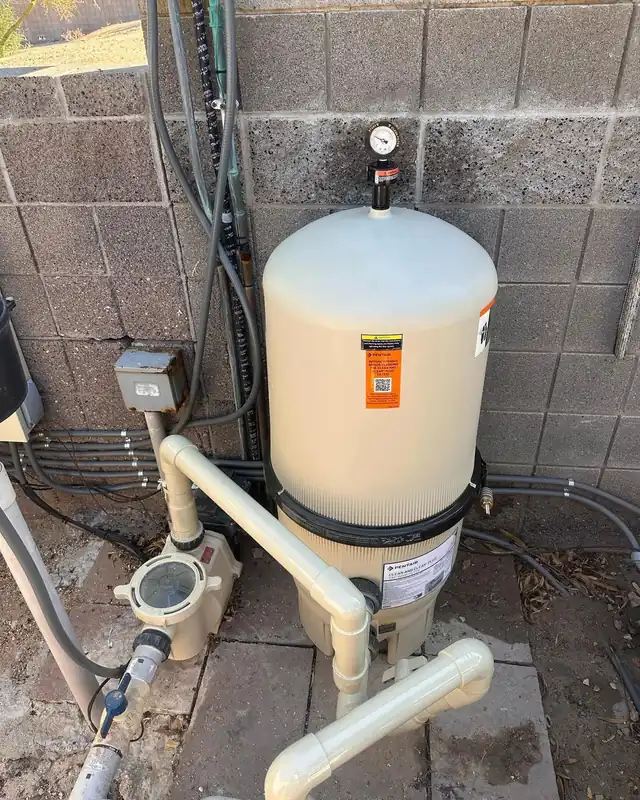
The pump gets the attention because it's loud and it's the part people replace. The filter does the work that actually keeps the water clear, and it's the piece most often ignored until the pool turns cloudy. Knowing how your filter works makes it a lot easier to see why it needs a deeper cleaning twice a year, and what the pressure gauge is trying to tell you.
How a cartridge filter works
A cartridge filter holds one or more pleated elements, similar in shape to a big accordion-folded sleeve. Water gets pushed through the pleats, and debris stays on the surface of the material. The pleats give a small tank a very large surface area to catch dirt on.
Cartridges don't get backwashed. They come out of the housing, get rinsed off, and go back in. The upside is that they're simple and don't waste much water. The catch is that rinsing alone leaves behind the oils and mineral film that sink deep into the pleats.
How a DE filter works
A DE filter uses a set of grids or fingers coated with diatomaceous earth, a fine powder made from the fossilized remains of tiny aquatic organisms. The powder builds a thin layer over the grids, and that layer catches very fine particles that a bare surface would let through. DE filters are known for polishing the water to a high level.
Maintenance is a little different. A DE filter gets backwashed to flush out the dirty powder, and then it's recharged with fresh DE. Over time, though, oils, sunscreen and minerals bake onto the grids and backwashing doesn't touch them.
Why twice a year
Most DE and cartridge filters should be cleaned twice a year, and that's the guidance Lakeside gives customers. The cleaning is an additional charge that depends on the type and size of the filter, since a large DE unit with a full set of grids is a different job from a small cartridge filter.
The desert is hard on filters. Fine dust blows in all year, the sun cooks oils into whatever's holding them, and hard water leaves mineral film behind. A filter can look fine from the outside and be coated inside. When it is, the pump has to push harder for less flow, and the pool circulates less water through the filter every day than it should.
What the pressure gauge tells you
The gauge on top of the filter is the easiest way to read what's going on inside. The useful habit is to know what the pressure looks like when the filter is clean, then watch for the number climbing. Every weekly visit includes a check of the filter pressure for exactly this reason.
- A reading that rises steadily between visits usually means the filter is loading up and is due for a backwash or a deep clean.
- A reading that jumps quickly after a storm points to a heavy load of dust or debris.
- A reading that falls well below normal can mean restricted flow ahead of the filter, such as a clogged basket, a suction-side air leak or a pump problem.
The exact numbers vary by filter and by system, so there's no single magic reading. The point is the change from your own baseline.
Signs it can't wait for the calendar
Sometimes a filter needs attention before the six-month mark. Watch for weak flow from the return jets, water that stays cloudy even when the chemistry looks balanced, a pump that sounds strained, or a filter you're backwashing more often than before. Any one of those is a reason to mention it to your pool service.
What a deep clean involves
For a cartridge filter, the element is pulled out, rinsed thoroughly, treated with a cleaning solution to break down oils and scale, rinsed again and inspected. For a DE filter, the grids are removed, cleaned the same way, checked for tears and reassembled with a fresh charge of DE.
The inspection matters as much as the cleaning. A torn grid or a collapsed cartridge pleat can't hold debris no matter how clean it is, and the fix at that point is a replacement element or a new filter. Lakeside handles filter cleaning and installs new filters, working with Pentair, Jandy and Hayward equipment.
Which type is better
Both are good filters when they're kept up. Cartridge filters tend to be simpler to live with. DE filters tend to filter finer but ask for more handling. The right one depends on the pool, the equipment already on the pad and how you want to handle upkeep, so it's a conversation worth having before a replacement rather than after.
If you're not sure which filter you have, when it was last cleaned or whether your gauge reading looks normal, call or text Tony at (480) 363-6158 or email tony@lakesidepoolservicellc.com and he can tell you what to look for.
Lakeside Pool Service LLC, (480) 363-6158
Call (480) 363-6158More articles
What a Weekly Pool Visit Should Cover in North Valley Heat
Every item on the weekly checklist has a reason behind it, and the desert makes most of those reasons more urgent.
Why North Valley Pools Turn Green After Monsoon Season
A green pool usually has a few causes stacked together, and most of them trace back to circulation and chlorine demand.